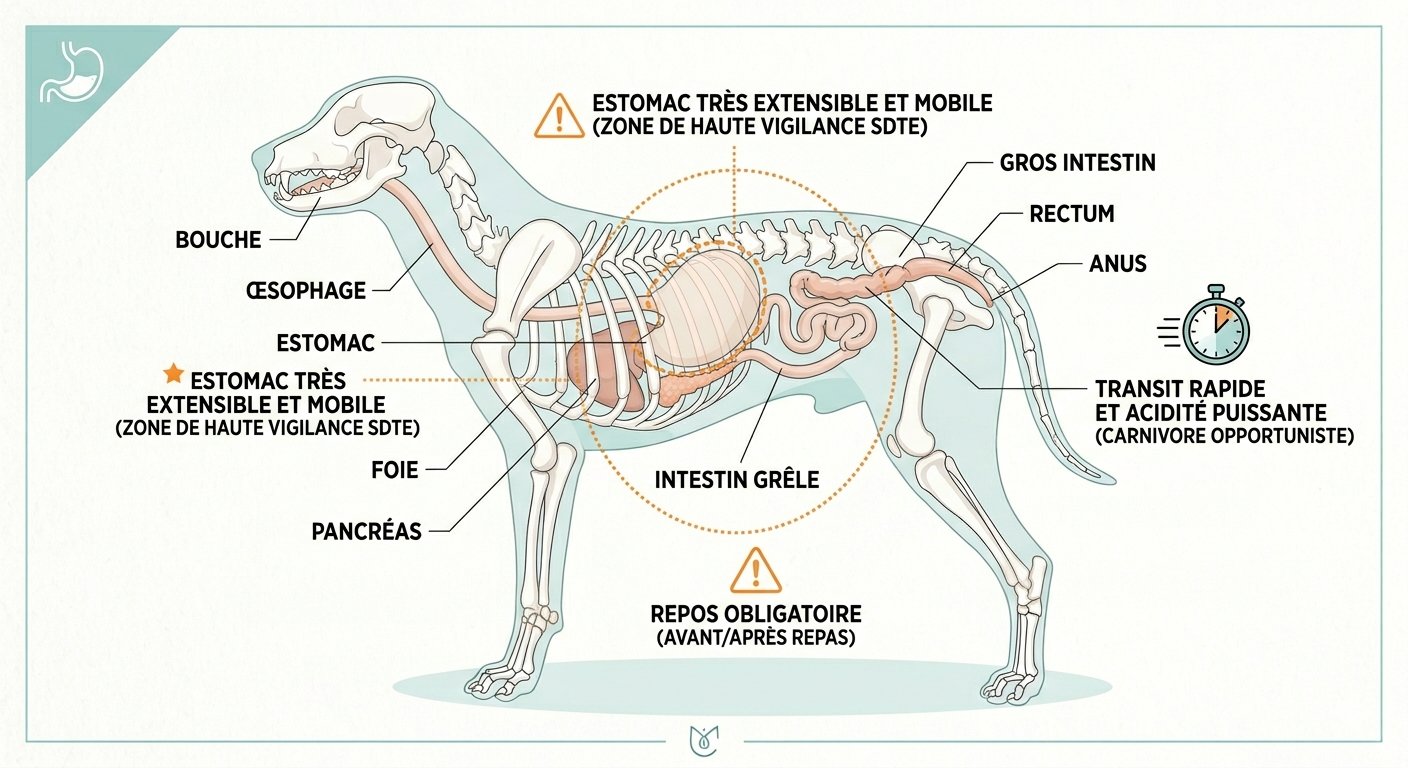
A dog does not chew in order to digest, but to crush and swallow. Digestion really begins in the stomach.
It is a large “suspended” pouch that can hold enormous quantities. Unlike in humans, a dog's stomach is fairly mobile within the abdomen.
It lasts between 4 and 24 hours depending on the type of diet (kibble, wet or raw).
Torsion happens when the stomach swells with gas (dilatation) and then twists on itself (volvulus), blocking both the entrance and the exit as well as the blood supply.
🚨 Signs that mean you must get to the vet straight away (within 30 minutes):
Ideally give 2 to 3 meals a day rather than one big one.
No sport, no jumping, no wild games 30 minutes before and 3 hours after a meal.
If your dog “inhales” their bowl, use a slow-feeder bowl or scatter the kibble on the floor to slow down the amount of air swallowed.
Contrary to popular belief, raising the bowl can sometimes increase the risk of swallowing air. The floor remains the most natural position.