← Back to the client area
Dog knowledge

The Skeleton
Growth & Bone Health

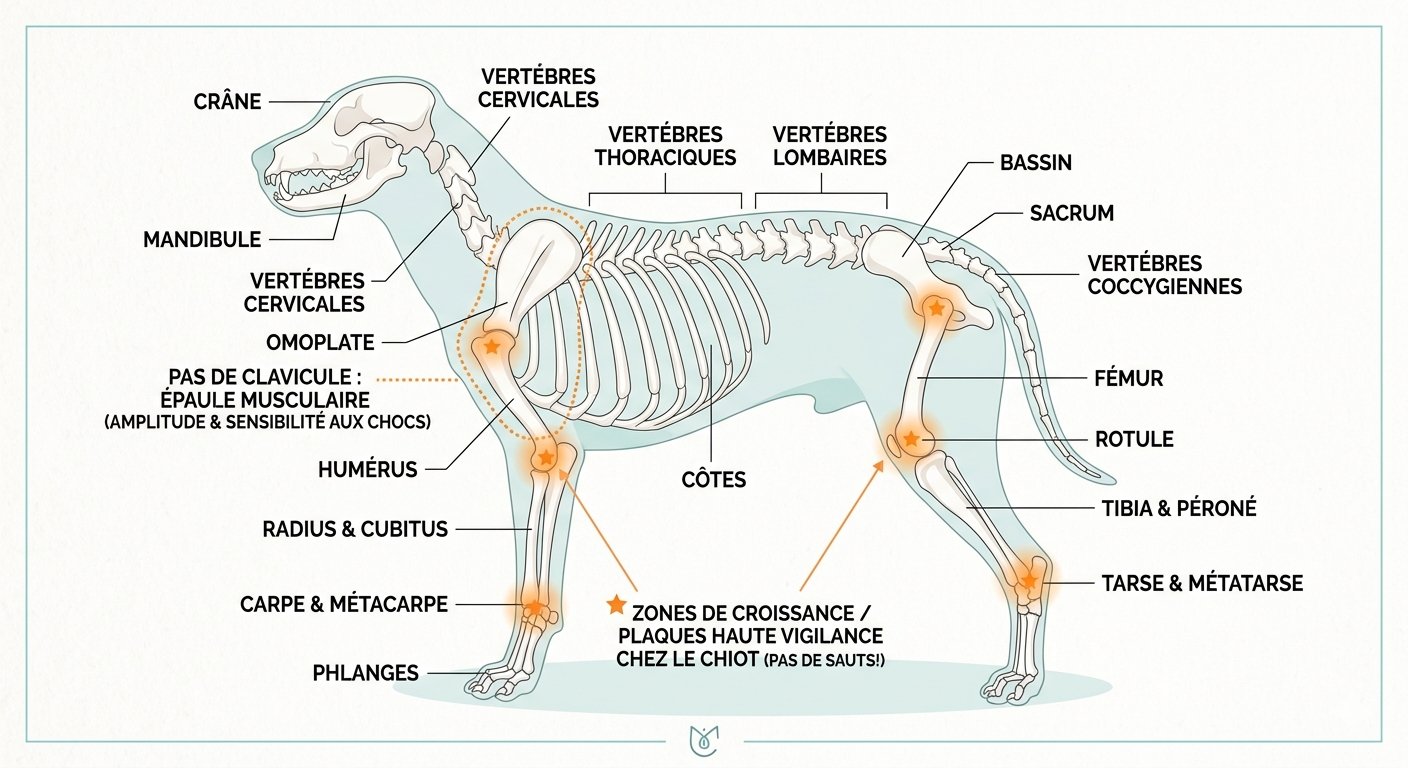
The skeleton is a living structure of around 320 bones. Dogs have no true collarbone, which makes their shoulders very sensitive to impact.

1Growth 2Common conditions 3Recognising pain 4The care pathway 5Mistakes to avoid
🦴 Anatomical diagram: the dog's skeleton
Diagram of a dog's skeleton with the growth areas labelled
📏 1. Growth: a period that needs close watching▼

Until the growth plates (areas of cartilage at the ends of the bones) have closed, the skeleton is soft and fragile.

📅 End of growth
Between 10 months (small breeds) and 24 months (giant breeds).

The Consistency rule

Repeated trauma during growth (e.g. jumping out of the car boot every day) can mean 10 months of rehabilitation or treatment in adulthood.

🔍 2. Common skeletal conditions▼
🦴 Dysplasia (hip or elbow)

Malformation of the joint. Signs: A rolling gait, difficulty getting up, refusing to jump, lameness when “cold”.

⚙️ Arthritis

Wear of the cartilage. Signs: Stiffness on waking, the dog often licks one particular joint, less enthusiasm for walks.

🦵 Luxating Patella

Common in small breeds. Signs: The dog runs on three legs for a few metres, then carries on normally.

🔥 Panosteitis (Growing Pains)

Inflammation of the bone. Signs: Shifting lameness (left one day, right the next) in a young dog.

👁️ 3. How can you recognise pain?▼
⚠️ Dogs are experts at hiding pain behind excitement
Change in behaviour

More irritable or quieter than usual.

Change in posture

Arched back, head held low.

Asymmetry at the trot

The head “nods” when one leg touches the ground.

🏥 4. The care pathway▼
The Vet (the medical diagnosis)

An essential first step. X-rays, CT scans and ultrasound to confirm the diagnosis. Anti-inflammatories or chondroprotectors prescribed if needed.

The Canine Osteopath (mechanics and comfort)

For prevention: an annual visit is recommended. For follow-up: after a knock, or to ease a chronic condition (arthritis). Osteopathy does not replace surgery; it complements it.
⛔ 5. Mistakes to avoid at all costs▼
🚫 Self-medicating
Never give your dog human painkillers (such as paracetamol or ibuprofen). They are toxic and can be fatal for dogs.
🚫 Ignoring a “small” limp
A dog that limps is in pain. If he still plays, it is adrenaline masking the pain, but the damage to the bone is getting worse.
🚫 Excess weight
It is the skeleton's worst enemy. Every extra gram weighs on fragile joints.
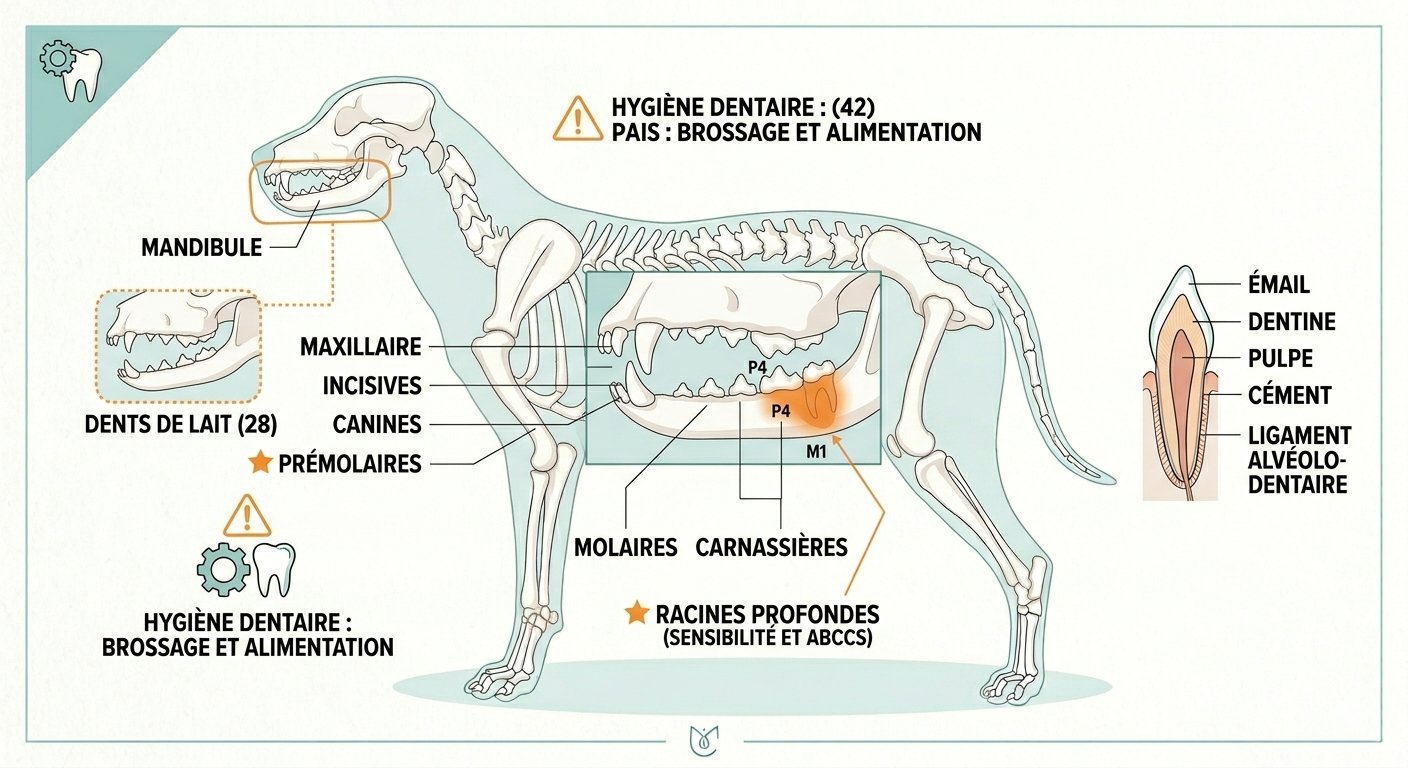
🦷 Anatomical diagram: the dog's teeth
Diagram of a dog's teeth showing incisors, canines, premolars and carnassials